

- Patient Stories
- Zhang Guangshun
From unbearable pain to a peaceful night's sleep: a patient's story of having a Tumor "frozen" off his aorta
My name is Zhang Guangshun. I'm sixty years old. Before last autumn, I never believed there was such a thing as pain that could keep you awake all night long.
I spent my whole career working in the railway maintenance department. Sleeper ties, track ballast, steel rails – everything I dealt with was hard. My bones got used to that hardness after decades of working with those iron things. I thought I was tough enough. But when this illness came, I learned that bones are no match for a tumor.

(Images 1-2: Patient's lung CT showing the lesion; Images 3-4: Intraoperative needle placement and ablation; Images 5-6: Post-op CT showing complete tumor ablation)
At first, it was just a dull ache in my back – like the usual soreness after a long day of hauling track ballast. My wife told me to get it checked out. I waved her off: "Just an old injury. A couple of plasters will fix it." But the plasters didn't help. The ache turned into a deep, heavy pain. Eventually, it felt like an invisible hand was gripping my back and chest all day. At night, lying flat made it worse. I couldn't even take a deep breath without it hurting. I'd wake up in the middle of the night, sit on the edge of the bed, stare out at the dark sky, and wonder when dawn would come. But when dawn came, the pain was still there.
My son got worried and dragged me to the city hospital. A contrast-enhanced CT scan came back with a report that said: Posterior mediastinal mass, suspected malignant tumor. That wasn't even the worst part. The doctor called my son over to the lightbox, pointed at the jagged shadow on the scan, and said: "See this? The tumor is pressing right against the descending thoracic aorta. It's like a piece of chewed-up gum stuck to a high-pressure water pipe. A scalpel can't separate them. One wrong move, the vessel ruptures – and the patient is gone in minutes."
That hit me like ice water. What followed – radiation and chemotherapy – nearly finished me off. Halfway through radiation, the skin on my back blistered and burned. The pain was worse than ever. Chemotherapy was even more brutal. I'd force down a little food, and it would all come back up in no time. My hair fell out within days. I dropped from 140 pounds to barely over 100. The most devastating part was when the doctor told us: the tumor had barely shrunk, and my body couldn't handle any more treatment. During those days, the pain never stopped. I often thought – living another day like this was pure torture.
Just when we'd run out of options, my daughter brought us good news. A colleague of hers had a relative with a similar condition, and that relative had gotten excellent results from a minimally invasive treatment at a hospital in Chengdu called Uni-Asia Cancer Hospital. The hospital had gathered a group of interventional specialists from China's top institutions – doctors who specialized in taking on the toughest cases that others wouldn't touch. My daughter showed me the hospital's information on her phone. I saw the words "argon-helium cryoablation," and the names of Professor Liao Zhengyin and Professor Luo Xiaoping.
With one last shred of hope, our whole family traveled to Chengdu.
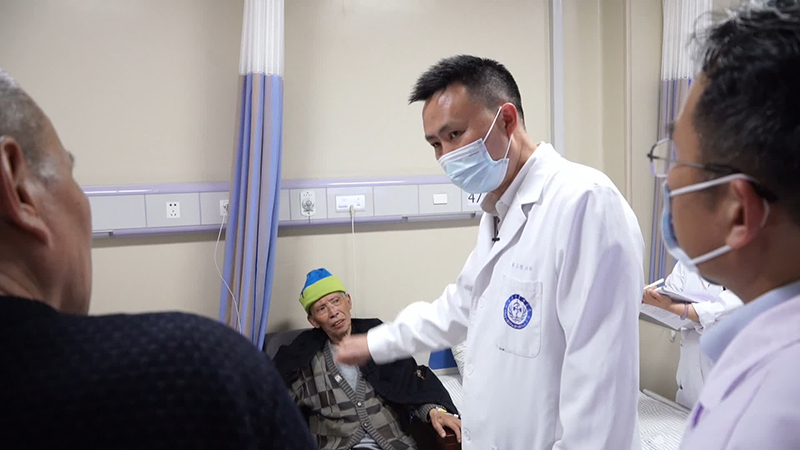
In the consultation room at Uni-Asia Cancer Hospital, Professor Liao Zhengyin carefully reviewed all my medical records. Unlike other doctors who just sighed and shook their heads, he took out a blank piece of paper and started drawing while he explained: "Mr. Zhang, your tumor is in a dangerous location – it's like a bomb pressed against a major artery. But there is a way to deal with it. It's called cryoablation."
To make sure I understood, he used an analogy: "We won't put you to sleep with general anesthesia. We'll just do local anesthesia in your back. Using CT as our 'X-ray eyes,' we insert a very thin freezing probe precisely into the tumor. The tip of the probe cools down to minus 160 degrees Celsius in seconds, forming an ice ball around the tumor about the size of an olive – and it freezes the tumor to death. This extreme cold triggers the body's own clotting protection mechanism. The ice ball wraps around the tumor, but it won't damage the aortic wall right next to it."
"But... what if it touches my aorta? The one they said would rupture?" I still wasn't convinced.
Professor Liao smiled, his eyes steady and confident. "Our goal is to sculpt the ice ball into a precise weapon that kills only the tumor and leaves the blood vessel unharmed. We have extensive experience. You can rest assured."
On the day of the surgery, I walked into the CT intervention room on my own. Lying on the procedure bed, I could hear the calm, steady voices of the experts in the control room next door. Professor Luo Xiaoping personally performed the local anesthesia. He gently pressed on my back and reassured me: "Mr. Zhang, you'll feel some pressure – just hang in there." I felt a slight coolness in my back, but no pain at all. Then the CT scanner moved slowly into position. I heard Professor Liao's steady commands: "Path is safe. Avoid the aorta. Needle forward five millimeters... three millimeters... good. Tip is in position. Start freezing."
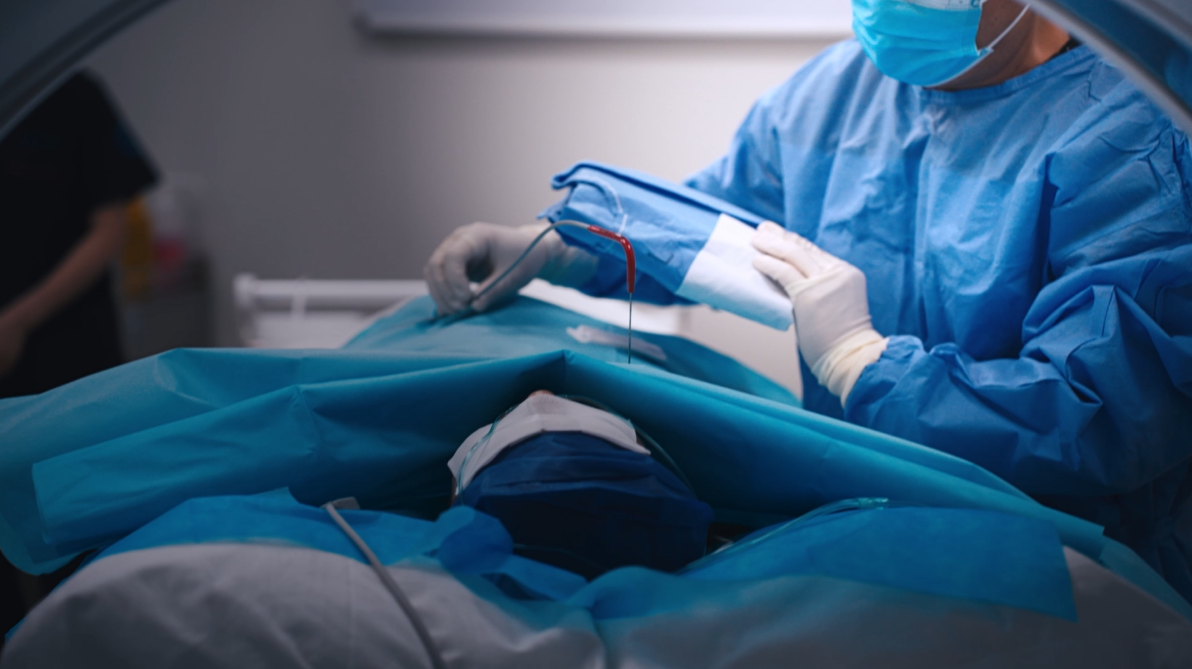
(Image: Doctors performing argon-helium cryoablation on the patient)
A cool sensation spread deep into my back – but it wasn't uncomfortable. It felt more like a cold towel gently pressed against the "fire source" of my pain. Less than two hours later, the procedure was done. The nurse smiled and told me: "Mr. Zhang, the ice ball formed beautifully – it covered the entire tumor. And that big blood vessel right next to it? Beating just fine, completely unharmed."
Then something incredible happened. As I was wheeled out of the operating room, the deep, gnawing pain that had tormented me for nearly a year – the pain that had kept me up night after night – was gone. It was as if that freezing needle had pulled it right out of me. That night, I lay flat on my bed and slept through the whole night, soundly, until morning. That hadn't happened in over a year. The next morning, I was able to get out of bed and walk with my son's help. There was only a tiny pinprick mark on my back.
Now I'm back home and fully recovered. Every day, I play gateball with my old buddies and take my grandson to school. My neighbors and friends all ask me in surprise: "How did you get your color back so quickly?" I always puff out my chest and tell them: I met a team of doctors who can "treat illness with ice." Right in the most critical part of my body, they performed a brilliant piece of microscopic sculpture – and saved me from that bone-deep pain.
Thank you to Uni-Asia Cancer Hospital. Thank you to Professor Liao, Professor Luo, and their entire team. You gave a man who was sentenced to death a second chance at a peaceful life. I will remember this kindness for the rest of my life.